

 Français
  Türkçe
 AI in Rhinoplasty: 3D Planning, AR Guidance & Recovery
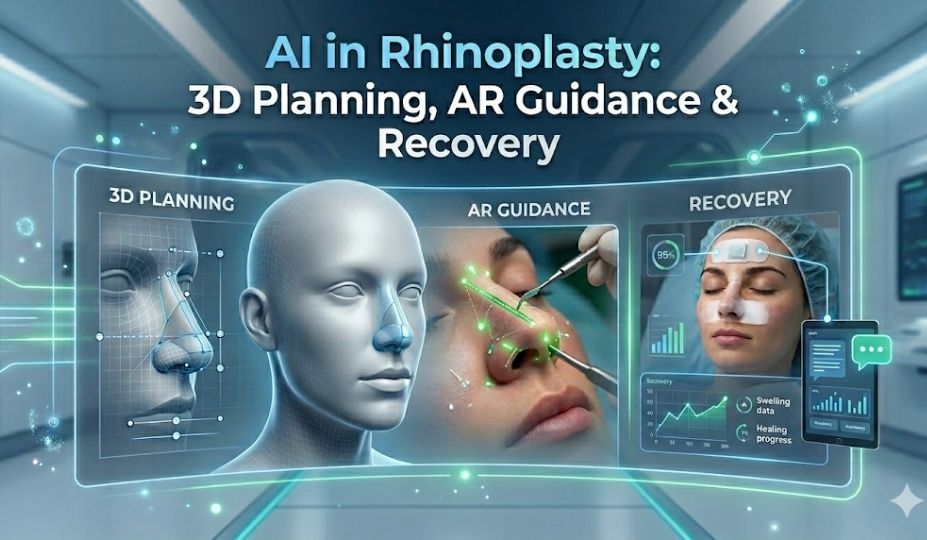
Nose surgery (rhinoplasty) is one of the most complex procedures in the medical world, blending the surgeon's technical expertise with an artistic perspective. Today, this field is undergoing a major transformation thanks to the ability of computer systems to analyze vast amounts of data and identify specific patterns. Intelligent algorithms have become surgeons' most powerful allies at every stage—from personalized surgery planning to millimeter precision during the operation, from monitoring the recovery process to ensuring patients are properly informed.
This article details the current solutions that digitalized surgical methods have brought to rhinoplasty and how these technologies will transform rhinoplasty into an even more personalized discipline in the future.
The effects of artificial intelligence (AI) on rhinoplasty
Pre-surgery: Flawless planning and realistic expectations
Data analysis:
The most important issue that rhinoplasty patients are curious about—and also concerned about—is how they will look after surgery. Artificial intelligence aims to eliminate this uncertainty. The greatest power of artificial intelligence comes from its ability to process millions of pieces of data simultaneously, which is many times more than a surgeon could encounter in their entire career. These systems minimize uncertainties in the surgical process by analyzing complex anatomical structures that the human mind may struggle to analyze in a matter of seconds.
In modern rhinoplasty, this technology provides concrete guidance in the following critical areas:
- Case-specific strategy: Accurately determines the surgical technique that will yield the most successful outcome for a specific nasal anatomy.
- Outcome-focused prediction: Analyzes how the surgical approaches applied will reflect on patient satisfaction by comparing the success of thousands of cases.
- Risk and safety management: Identifies factors that increase the likelihood of complications in advance, providing the surgeon with a safer and more predictable surgical plan.
Modelling and simulating in 3D:
- Digital "face sculptures" made with photogrammetry and high-resolution scanning technology have gotten rid of any doubts about how the nasal structure will change after rhinoplasty. Surgeons can use these three-dimensional models made from pictures of the patient to do realistic simulations that show what the surgery will look like. These digital platforms make it easier for the patient to talk to the surgeon by turning their expectations into clear phrases. This lowers anxiety and makes the patient happier after surgery.
- This technology can do more than just change how things look on the outside. Intelligent technologies can predict how the airways will work after surgery by looking at the structural parts of the nose. This lets both aesthetic and functional planning happen at the same time.
- Machine learning techniques are employed in aesthetic analysis. These models look at important geometric facial traits, including nasofrontal or nasolabial angles, by comparing them to thousands of successful cases. So, the algorithm can objectively suggest the proportions that will work best with the patient's particular facial features and provide the surgeon the best-looking outcomes.
Personalized recommendations:
- Today's technology can look at the mathematical proportions of a person's face (such as the golden ratio and facial thirds) and suggest the best nose shape for them. Artificial intelligence, on the other hand, goes a step further by looking at dozens of elements at once, like the patient's race, gender, age, skin thickness, and how their facial expression changes over time. This makes a design that is not only "mathematically perfect" but also "perfect for that person."
- AI algorithms look at the patient's medical history, genetic predispositions, allergies, and lifestyle data to develop a risk profile just for them. For instance, it can find things that might slow down wound healing ahead of time, which lets the surgeon change the way they do the surgery.
During surgery: augmented reality and robotic accuracy:
The surgeon is no longer the only one at the operating table; cutting-edge tools are there with them. These systems make every action, from cutting to moulding, more controlled, predictable, and safe.
Augmented reality (AR):
Augmented reality shows the surgeon a thorough plan that was made before the surgery, usually using special glasses or screens. The surgeon may see the modifications they want to make to the nose, the measurements, the recommendations, and the target locations in real time. For instance, you can view and keep track of things like the height of the bridge of the nose, the lift of the tip, and the angles at which bones are removed right away. The surgeon can use this information without having to look up or get other instruments. This speeds up decision-making and makes sure that the plan and reality are as close as possible.
Robotic assistance:
- Robotic systems can do things that the human hand can't, especially when it comes to delicate and precise operations. They do things like suturing, cartilage shaving, or bone contouring with great stability and repeatability because they get rid of things like tremors, weariness, or small misalignments.
- The system carries out commands with perfect accuracy when the surgeon controls the robot. This method causes less harm to tissues, less bleeding, and in the end, it leads to more natural, clean-lined aesthetic results. Robotic assistance is becoming a potent tool that works with the surgeon's competence, even though it isn't yet used in every facility on a regular basis.
Recognising anatomy:
- It is very crucial to rapidly tell the difference between cartilage, bone, septum, and soft tissues inside the nose during surgery. Advanced image processing systems quickly look at images taken with an endoscope or microscope and automatically find and show these structures by colouring or labelling them. The surgeon can see unambiguous markers on the screen or in the field of view, like "the blue part is the lateral crus" and "the red area is the septum." This saves time, lowers the chance of accidently harming essential structures, and lets the surgeon focus more on strategic decisions, aesthetic harmony, and the ultimate outcome.
- These technologies are the surgeon's best friend during surgery. They make it much less likely that something will go wrong while still allowing the surgeon to use their hands and creative vision, which makes the results more reliable and consistent.
- Rhinoplasty is slowly changing from a "by-eye" approach to one that is guided by data and focused on precision.
After surgery, follow-up and education at an expert level:
The time it takes to heal following rhinoplasty surgery is the most important component of the whole process. During this time, patients ask a lot of questions and are worried. Things are a lot easier with artificial intelligence; the patient feels like an experienced surgeon is with them all the while.
Studies done with chatbots for learning:
Well-trained AI chatbots can answer queries on post-operative care that are almost as accurate, clear, and easy to comprehend as those of a rhinoplasty surgeon. When a patient asks, "Why is my nose still swollen?" in the middle of the night, they get straightforward answers instead of worrying.
Healing modelling:
AI can model how nasal tissues heal by looking at things like age, skin type, and the sort of surgery used. It produces forecasts that are specific to you, such as "Swelling goes down by 60% in the third week, and the final shape settles in 12 to 18 months." This helps patients understand what to expect, which lowers unnecessary stress.
Checking on wounds and scars:
Advanced algorithms look at photographs or daily follow-ups to find problems like infection, slow healing of wounds, or keloid/hypertrophic scars very early on. Is that a little red spot, or is it normal? AI sees this right away and says, "Show this to your surgeon right away." Early action reduces problems.
Change in how the patient feels:
Before rhinoplasty, patients would only talk about a few pictures. Now, thanks to AI, they can see what they might look like after the surgery. This modification is really crucial since it lowers patients' worry, boosts their confidence, and, most importantly, sets reasonable expectations.
Getting ready mentally and managing expectations:
Patients used to think that small changes made with 2D pictures would look unnatural and wonder, "Will it really look like this?" But now, thanks to AI-powered 3D models, patients can preview how their nose will look from all sides, in varied lighting, and even when they smile, scowl, or talk. We can assess whether the nose fits with the natural movement of the face instead of merely a still image, thanks to these models that move with facial expressions. This makes it easier for the patient to say, "Yes, this will work for me," which greatly lowers the chance of being disappointed following surgery.
Being involved in the decision-making process:
With the help of artificial intelligence, patients may test out alternative nose forms on their own faces. They can lift the tip of the nose by a millimetre at a time, thin the bridge, or change the width if they want to. The patient is not just watching; they are also a part of the design. By being involved, they are more likely to be happy with the results after surgery—because the outcome is now a mutual decision between the surgeon and the patient.
Surgeons need new tools and skills
Because people have many different ideas about what is beautiful, it can be hard to judge aesthetic results. This is exactly where AI makes a big difference. It can turn personal opinions into standards that are easier to measure and compare. This lets surgeons see more clearly how well their procedures work with different types of patients and use this information to keep getting better.
Measuring and comparing things in a fair way
Surgeons can safely try out different surgical methods and learn how to deal with unexpected scenarios ahead of time thanks to simulations that are very close to real life. After each try, it's evident what they do well and what they need to work on. This gives training a much stronger base and lets each person make their own progress.
The future of AI in rhinoplasty
- It would be foolish to think about AI as something that will take the place of the surgeon's knife or years of experience. The actual strength of this tool is that it helps the surgeon make better, more informed choices. This makes rhinoplasty a more safer and more controlled operation than it used to be, when it was based on guesswork. The procedure also gets easier for patients to grasp and predict.
- From the first meeting to plan the operation to the surgery itself and then the follow-up care, it is much easier to make decisions at each step. But these evaluations by themselves never decide the outcome. The surgeon still has the last say over the aesthetic, the balance, and the decision. This method not only gives better aesthetic outcomes, but it also builds trust between the patient and the doctor.
- No matter how modern technology gets, the core goal of rhinoplasty stays the same: to make the nose look good with the rest of the person's face, be healthy, and make them feel better about themselves.
- Artificial intelligence is just a tool here; the human factor always decides where to go.
Utilising genetic information
Researchers have been looking more closely at genetic factors that affect the anatomy of the nose, the strength of the cartilage, and the healing process in the last several years. Surgeons will be able to build much more personalised plans in the future by looking at the patient's genes. This seems to have a lot of advantages when it comes to regulating the healing process in a healthier and more predictable way.
Smart support systems that help during surgery
More advanced software can find any problems during surgery sooner. In particular, being ready for problems that come up unexpectedly makes it easier for the surgeon to act quickly. But these systems never make decisions on their own. AI doesn't take the job of the surgeon; it just helps and guides the process.
Trust and ethical limits
As these technologies become more common, protecting patient data and fair usage become more important. One of the most important things in this sector is making sure that all patient groups are treated fairly and equally and that their personal information is safe. To be genuinely reliable, artificial intelligence needs to be able to handle ethical issues as well as technical ones.
Keeping a close eye on the tissue throughout surgery
There are different ways to check the blood flow and health of nasal tissue during surgery. When these data are appropriately assessed, it is possible to see the risk of tissue damage considerably earlier and take the right steps in a timely manner. Because of this, the healing process goes more safely and smoothly.
Ethical and practical boundaries in AI
Artificial intelligence has prospects that could greatly enhance precision in rhinoplasty and facial aesthetics; yet, it also prompts major enquiries. Concerns of impartiality, data security, legal accountability, and clinical reliability remain inadequately defined. Because of this, bringing artificial intelligence into therapeutic application needs to be done carefully, slowly, and with a lot of thought.
Things to think about from an ethical point of view
One of the most fundamental moral questions is whether the systems give everyone the same level of accuracy.
Problem with the data source and how it is shown
A lot of today's AI models are trained on a small number of patient characteristics. When data is mostly from people with fair complexion and certain face types, it can give wrong results for patients from other ethnic groups. This can unintentionally result in inequity in aesthetic assessments.
Patient consent and data security
Pictures of people's faces and health information are very private. There must be very explicit regulations about how they are kept, who may see them, and why they are used. Legal compliance is technically doable, but in practice, it takes a lot of attention and responsibility.
Patient freedom and hopes
Some patients may have inflated expectations because of simulation images made by artificial intelligence. So, it should be obvious that "this is only a possible prediction." Patients make better choices and have more faith in the process when they realise this.
Where accountability starts
Who is in charge when something goes wrong? The surgeon? The group that made the software? Or the business that made the system? This uncertainty is still one of the most important ethical issues in the clinical usage of AI.
Real-world problems
The integration of technology into clinical practice poses numerous obstacles, both ethically and in terms of practical implementation.
Problems with the data
To get reliable results, data sets need to have a wide range of different patient profiles. However, in plastic surgery, there isn't much data, and what there is is spread out. This makes it hard to train models correctly.
Not enough clinical experience
Most research have utilised historical data. There is currently not enough prospective, large-scale clinical research on real patients. Because of this, many applications are still seen as experimental.
Language and cost problems
AI tools that work well are generally not cheap. Some patients may turn to free alternatives that aren't always reliable because of this. Also, since most systems work in English, patients who speak other languages have trouble getting to them.
The relationship between the doctor and the patient
No matter how advanced technology gets, the most important thing will always be the trust between the surgeon and the patient. The doctor should not be replaced by artificial intelligence; it should only be a helpful tool that does not take the place of clinical decisions.
F.A.Q
Can AI do rhinoplasty surgery on its own?
No, AI does not do surgery. It is a tool that helps the surgeon make a decision. It can help with planning, but the surgeon always decides how to do the surgery.
Can AI tell me when I will see the outcomes of my surgery?
It can tell you about how long it will take. However, it can take months for the final look in rhinoplasty to show up, and this time frame is different for each person. Your surgeon is always the best person to judge how well you're healing.
Is it safe to acquire information from AI when I can't talk to my doctor?
It can help you with basic and general questions. If something unexpected happens, such as discomfort or swelling, you should always talk to your doctor. AI does not take the place of emergencies.
How close do AI-based simulations come to real life?
These pictures are meant to depict possible outcomes, but they don't guarantee exact results. How well the tissue heals, the surgical method, and the structure of the tissue all play a role in the final result.
What is the most dangerous thing about using AI in rhinoplasty?
When it is taught with wrong or missing information, it is. Results can be deceiving, especially if there aren't enough people of diverse races and facial types in the study.
Is it possible to employ artificial intelligence on all patients?
Each patient is unique. It can help in some situations, but the surgeon needs to decide when and how to utilise it.
Op. Dr. Çağatay Ruhi
ENT Specialist · Rhinoplasty Surgeon
Graduate of Hacettepe University Faculty of Medicine. Practicing ENT and rhinoplasty in Istanbul Kadıköy since 2011. Specialized in rhinoplasty, revision rhinoplasty, preservation rhinoplasty and piezo surgery with over 5,000 successful cases.